MATH105 Quantitative Reasoning — Rick Barth

Registration: typically 30 Students (in spring 2020 there were 42 students)

In Spring 2020, I met with students by video during the first week to get acquainted and to demonstrate the software platforms and routines of the course, but otherwise I conducted this class entirely asynchronously. This was in part because the number of students in the class was quite large, and in part because I wanted to spend my time on other pedagogies. I prioritized my time to making 3-times-per-week video lectures and providing same-day feedback on student work, which was also due 3 times per week.

Student feedback from this course, as well as from other students who replied to the TLC student survey in 10th week leads me to plan for next spring to re-use some of the asynchronous content, update some asynchronous content but with less emphasis on synthesizing earlier material, and to add real-time group meetings with students in order to provide more support to students who didn’t get enough personal connection from the routine of submitting work and receiving quick personal feedback.

Workload in a typical week of MATH105
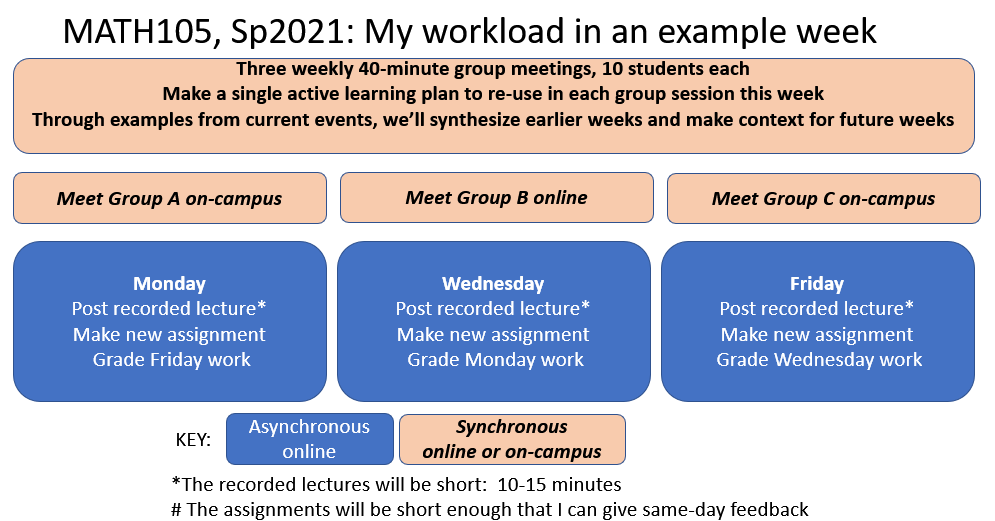
The content of this figure is repeated below in a form suitable for screen reader software.

Three weekly 40-minute group meetings with 10 students each. A single active learning plan to re-use in each group section during the week Through examples from current events, we’ll synthesize earlier weeks and make context for future weeks.

Monday

  • post short recorded lecture
  • make a new assignment
  • grade Friday work
  • Meet Group A synchronously

Wednesday

  • post short recorded lecture
  • make a new assignment
  • grade Monday work
  • Meet Group B synchronously

Friday

  • post short recorded lecture
  • make a new assignment
  • grade Wednesday work
  • Meet Group C synchronously

The recorded lectures will be 10-15 minutes. The assignments will be designed so as to allow me to provide a quick turnaround—hopefully same-day.
COMP 320 Principles of Programming Languages — Alyce Brady

(Spring 2020, Re-envisioned for future hybrid offering)

Enrollment: 37 students  (should have been more like 15)

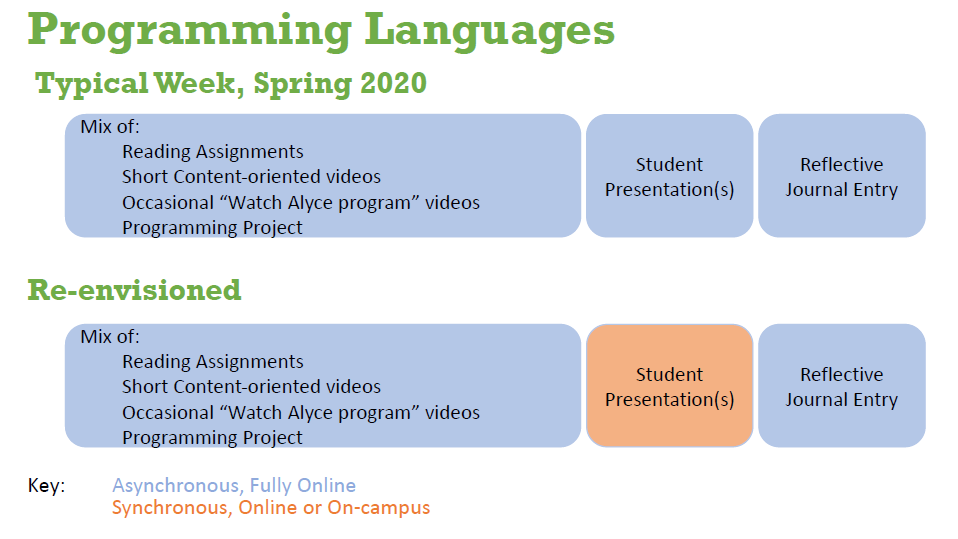
Under normal circumstances, this course meets three times a week for a mixture of lecture, some group-work, and weekly presentations by students.  When enrollment is high, students present in small groups with each group presenting just once in the quarter.  With smaller enrollments, students have presented individually or more than once.

In Spring 2020 we went completely online and, since this course had students in South Korea, San Diego, and many places in between, completely asynchronous.  Given the number of students, I switched from weekly homework assignments to weekly reflective journal entries, a successful change that I intend to keep regardless of the size or format of the course in the future.  One thing I would do differently, though, would be to add a synchronous component consisting of the student presentations and possibly a class-wide Q&A.

COMP 105 Introduction to Computer Science — Alyce Brady

Enrollment: 32 students

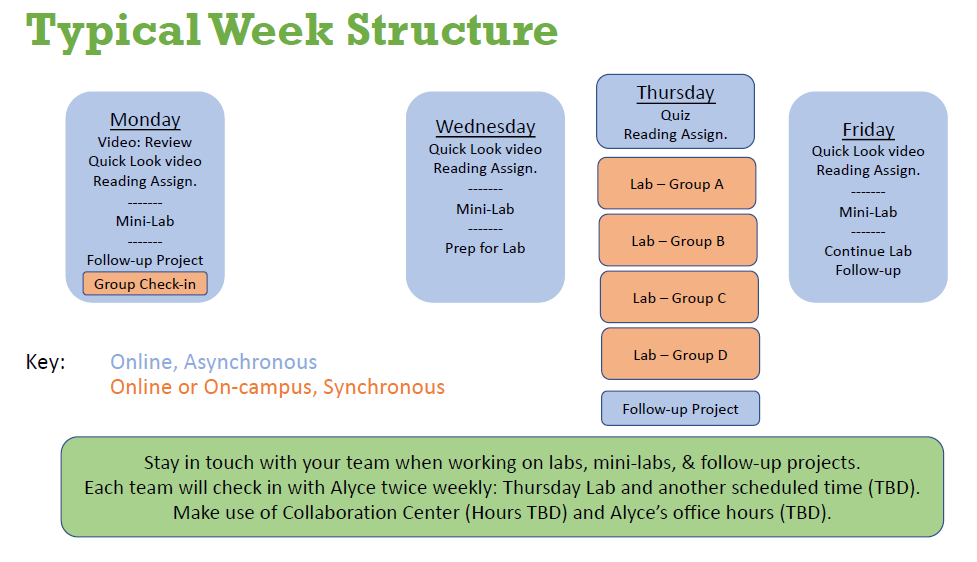
Usually would meet 4 times a week (3 lecture/mini-lab classes and a full lab each week); there are usually 2 lab sections of approx. 15 students each.

Under normal circumstances, the most valuable interpersonal interactions are during the lab/mini-lab times, when students work side-by-side, asking questions and comparing approaches, and I circulate, checking in with students and answering questions.  Clustering around laptop screens is the norm.  Since this is the antithesis of social distancing, our most significant interactions will move to software-based screen sharing.

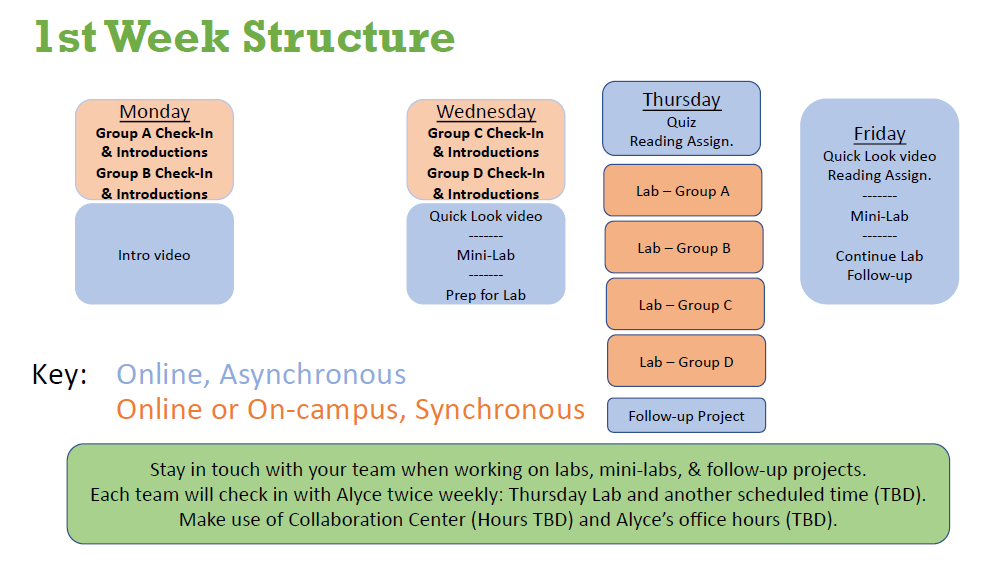
For the fall, there are 32 students enrolled. I plan to break them up into 4 sections of 8 students each, since that is a reasonable “covid-cap” for the lab/classroom space. I will probably also break each section into 2 smaller “support groups” of 4 students each.  My plan for Week 1 (and possibly Week 2) is to meet with each section twice in person, once during a usual class time and once during the lab.  The focus will be on introductions, community-building, and answering questions.  Content engagement (reading, short videos, mini-labs) will be asynchronous, on their own.